Your Hamstrings Are Not Tight. They’re Exhausted.
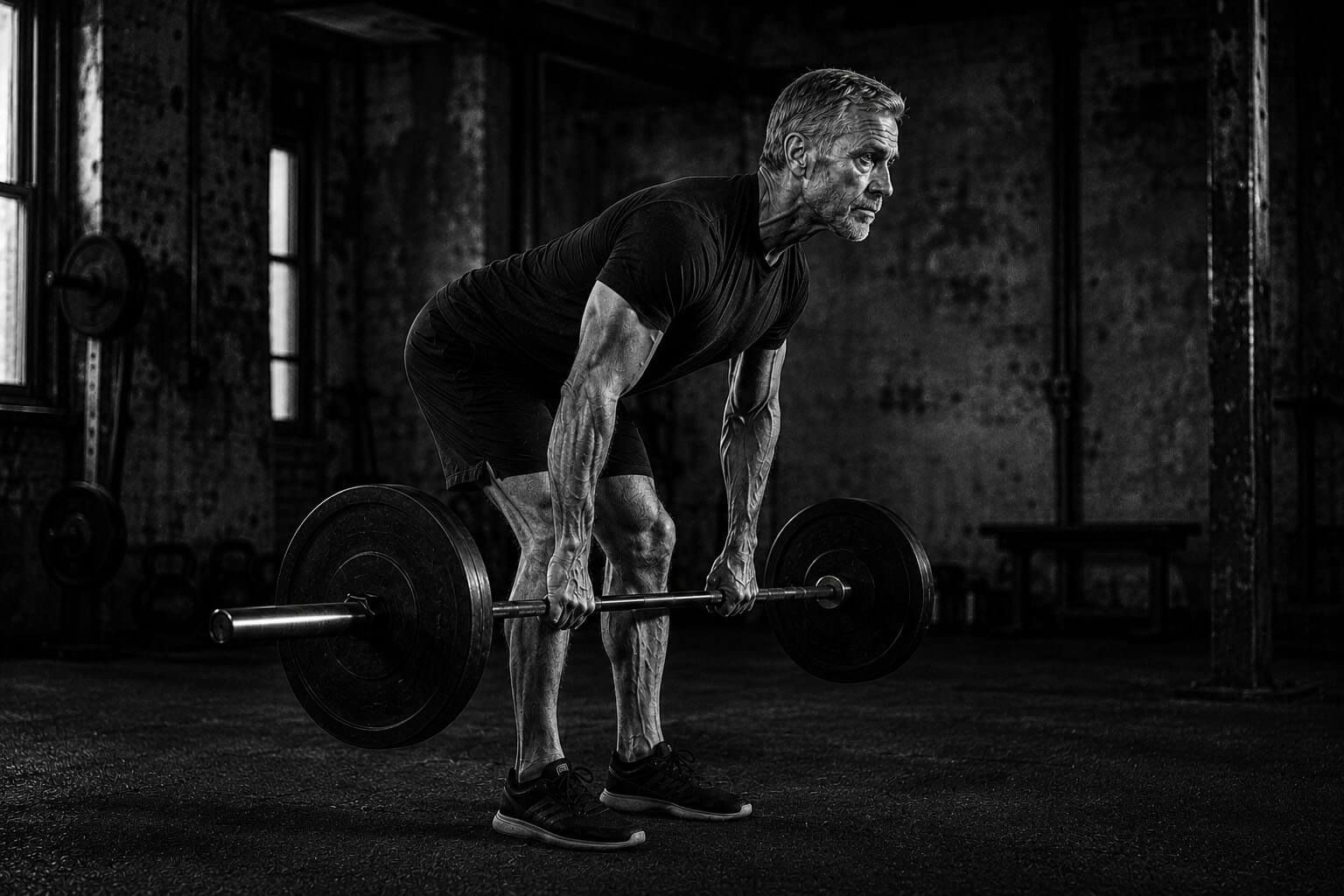
The Muscle Everyone Ignores Until It Breaks.
Most people who train legs think quadriceps. The quads.
The large front thigh muscles. You see them. You feel them burn on a leg press.
But the real workhorse is hiding in the back. The hamstrings (or “hammies”).
Your quads push. Your hamstrings pull.
Both matter. But those flexing quads get all the attention.
The forgotten hammies often do more work than they should, covering for muscles that have stopped pulling their weight.
Hamstring strains are common, often because the posterior chain, your backside muscles from top to bottom, is not being trained right.
On a leg press machine, your hamstrings kinda nap while your quads do all the work.
Do that for years, and the imbalance builds up quietly until something gives.
Squats and leg presses also recruit the glutes. But for most people over 50, the glutes are unresponsive from years of sitting, and no amount of leg pressing fixes that.
The result is a body that is not functioning the way it should.
Here is what’s going on, and why stretching is not the answer…
According to the National Academy of Sports Medicine (NASM), hamstrings are overactive, overworked, and stressed.
When glutes become underactive, hamstrings take over hip extension, the pushing-back motion behind every step, every stair, every time you stand up.
So the hammies, a helper muscle, are now doing the primary muscle's job. Basically… your glutes go quiet, and your hamstrings pick up the slack. We call this synergistic dominance.
You just need to know it is a problem.
Add in anterior pelvic tilt from prolonged sitting. That’s when your front pelvis tips downward and your lower back arches, pulling your hamstrings into a stretched position.
The result is an overstretched and "neurologically tight" muscle.
Double yikes!
AND… Here’s the part most people get wrong. You feel tightness in the back of your legs and assume you need to stretch.
BUT your hamstrings are already overstretched.
Your hamstrings feel tight, but they are really just overworking to protect you, they aren't actually short.
Aggressively stretching an already overstretched muscle triggers a protective response from your nervous system.
It tightens the muscle to protect it from tearing. The tightness you feel is not a flexibility problem. It is a stability problem.
So the real problem is not tight hamstrings. It’s glute weakness. The hamstrings are not the problem. They are covering for one.
This is fixable, so keep reading…
Your Hamstrings
The hamstrings are not one muscle. There are three.
The Big Boy! On the outside:
The Biceps Femoris is the largest of the group and has two heads, long and short. The long head crosses both the hip and the knee, making it the workhorse of hip extension and knee flexion.
It sits on the outside (lateral side) of your thigh. It also helps rotate the lower leg outward when your knee is bent.
This is the muscle most people strain, and for good reason. It does the heavy lifting every time you walk, run, or change direction. It is also the primary brake when you need to stop fast.
The Two Semis!
The inside of the hamstrings is made up of two muscles. Both named "semi," which means half.
Semitendinosus sits on top, closer to the surface. It is the smaller of the two, with a long tendon and a shorter muscle belly. A key player in knee flexion and hip extension.
Semimembranosus is tucked underneath, broad and flat. It also contributes to knee flexion and hip extension, and helps rotate the lower leg inward when the knee is bent.
Remember: tendinosus on top of the membranosus. 🎶 You are welcome. 😂
Why origin and insertion matter.
All three hamstrings (with one exception) originate at the ischial tuberosity, your “sit” bones.
The exception is the short head of the biceps femoris, which originates on the femur. They all insert below the knee, on the tibia or fibula, depending on the muscle.
That two-joint crossing means your hammies work at BOTH the hip and the knee.
They extend the hip AND flex the knee. This is why exercise selection matters.
A traditional hamstring curl only trains knee flexion.
Romanian deadlift loads the hammies through a full range of hip motion, eccentrically (meaning the muscle is lengthening, like a controlled lowering) during the hinge down, and concentrically (the muscle shortening and contracting) as you drive back up.
You need both movements to train the whole muscle.
One more thing worth knowing…
When the biceps femoris is overactive, it can pull the lower leg into external rotation, often showing up as feet turning outward during movement.
This is a common compensation pattern in 50+ people and a sign that the lateral hamstring is doing more than its share. If you or your clients walk or squat with toes pointed out, the biceps femoris is worth assessing.
What Your Hamstrings Actually Do
Think of the hamstrings as the engine and brakes of the posterior chain.
They assist the glutes in driving the hip into extension. Think of the back half of a walking stride, when your leg pushes behind you to propel you forward.
I know. I know. This is a lot, but stay with me…
When the glutes do their job, it’s a team effort. When they are not, the hamstrings are doing it alone.
They help stabilize your knee, keeping it moving the way it should. Here is why that matters. The ACL is one of the major ligaments holding your knee together.
Your hamstrings are the primary muscle helping it do that job. When the hamstrings are weak, the ACL picks up the slack.
Over time, that is a BIG problem.
Hamstrings are your body's brakes.
Every time your foot hits the ground while walking or running, your hamstrings control deceleration. Working on the way down. The lengthening phase.
The phase most people never train.
AND… That is when injuries happen!
This is because when the hamstrings can’t brake, something gives… Usually, the muscle itself.
Most hamstring strains are not freak accidents. They are the result of a muscle that was never trained to handle the demand placed on it.
If injury prevention is the goal, training the hamstrings during that lengthening phase is where you start.
But first, you need to understand why this happens.
3 things make hamstring problems almost inevitable.
1. Prolonged sitting pulls hamstrings into a lengthened position. Not a stretched, healthy lengthening. A passive, weakened one.
Here is what I mean...
There’s a difference between a long and strong muscle, and one that’s lengthened from hours of sitting.
One is active and loaded. (Think of an athlete in mid-stride.)
The other is just kinda hanging there, losing its ability to generate force.
Prolonged sitting also shuts down your glutes.
Weak glutes and overworked hamstrings are a package deal. You rarely get one without the other.
Fact: Prolonged sitting is REALLY bad for you!
2. Years of quad-dominant training, like leg presses and squats, make the front of your body stronger.
Result?… The back of your body falls behind.
And this strength imbalance means the weaker side pays for it.
3. The less you challenge the hamstrings, the less they protect you.
Overactive does not mean strong. It means the hamstrings are being overused in the wrong way, compensating for underactive glutes.
That overuse leaves them fatigued, poorly conditioned, and vulnerable.
BUT if you train them through a full range of motion, it builds the resilience they’re missing.
Overworked hamstrings that have never been properly trained are one sprint, one awkward step, or one heavy lift from a strain.
Here is the deeper reason why…
Every muscle has an optimal length at which it produces maximum force.
Chronic lengthening from sitting is not the same as stretching.
When you stretch, muscles temporarily lengthen and then return to their normal state.
When you sit for hours every day, the muscles are slack for long periods with no load and no recovery.
That adds up fast.
Over time, it loses its ability to generate force at the length it is stuck in. The muscle is there. But not able to do its job.
So what is your hamstring fix?
Stretching is not the enemy. But it is not the starting point either.
Here’s why…
Tight muscles are often just bodyguards for misaligned joints. When a joint is out of its natural position, muscles lock up to protect it from injury. That lock-up is what feels like tightness. Stretching the muscle is just a temporary fix because it does not solve the joint issue.
Your hamstrings are already stretched and braced because of things like anterior pelvic tilt, your hip tilting forward and pulling everything out of its natural position.
That resistance is not a flexibility problem. It is your nervous system protecting a joint that is out of position.
So stretching a muscle that is already overstretched is not going to solve the problem. The fix is teaching the hamstring to work properly first.
1. Get it strong and functional. 2. Restore the joint position. 3. Then stretch… In that order.
That is what proper strength training does.
But first, the root cause needs addressing. Your hip flexors.
When they are tight from sitting, they tilt the pelvis forward, stretching the hamstrings further and shutting the glutes down at the same time.
Loosen the hip flexors first.
Strengthen the glutes second.
…then train your hamstrings through a full range of motion.
That is why we start with the Romanian Deadlift.
Instead of just pulling on the muscle, the RDL makes it work while it is in that stretched position.
That builds the stability and strength the muscle needs. And over time it helps put everything back where it belongs.
How to Train Your Hamstrings After 50 (And Finally Get It Right)
Romanian Deadlift (RDL)
This is the foundational hamstring exercise for anyone over 50.
Start with a single kettlebell. Why?
One kettlebell sits centered between your feet, teaching you the straight up-and-down path. Start with a barbell and most people let it drift forward. That forward drift is where lower backs get unhappy. Not so with a kettlebell!
The RDL moves straight up and down. But what drives that movement is your pelvis. Your hips must push backward as you lower the weight, and drive forward powerfully to stand up. Your arms just act like hooks holding the weight.
Think of your hips as the engine.
Here’s how to do the RDL:
Start standing tall, weight in hand, feet hip-width apart. This is your starting position and also where you finish each rep.
Feet: grip the floor with your toes to create a stable base.
Chest and spine: lift your collarbone and pull your shoulders back. This keeps your upper back from rounding as you hinge.
The hinge: push your hips back and let the weight travel straight down along your legs. Think of your pelvis tipping forward like a bucket pouring water.
The way up: push the floor away and imagine closing a drawer behind you with your glutes. Those two cues will do more than any technical explanation.
Finish strong: squeeze your glutes fully at the top to lock in the rep and lock in position.
Here’s how I teach RDLS:
Practice before you add weight. Grab a broomstick or PVC pipe and hold it against your spine. It should touch three points throughout the movement: the back of your head, your upper back, and your tailbone. Hinge. If the stick loses contact anywhere, your spine is compensating. Clean that up before you load the bar. Watch the 3-Point Test here.
Start with a kettlebell or single dumbbell. One weight centered between your feet teaches you the straight up-and-down bar path before anything else.
Once that feels solid, move to dumbbell RDLs. Angle them at 45 degrees against your thighs.
From there, progress to the barbell. Want to see the full breakdown? Watch Jeff Cavaliere nail it here.
Single Leg Romanian Deadlift
Everything the RDL does, but on one leg.
I love single-leg movements and honestly think they are better. If you think about it, walking, climbing stairs, stepping off a curb, all of those are one-leg movements.
Training on one leg builds balance and hip stability, and reveals when sides are out of balance.
That kind of imbalance is a common, often overlooked contributor to lower back and knee pain.
Stability Ball Hamstring Curl
Stability ball hammy curls don’t need a machine, and are safer if you have knee issues or are new to training. Awkward at first, but well worth it.
Two things to focus on. Keep your hips elevated so your body forms a straight line from your shoulders to your knees throughout the movement. And lower slowly on the way down… this is where the real work happens.
A Note on Nordic Hamstring Curls
Nordic curls top the research list for hamstring injury prevention. They load the muscle at its longest, most vulnerable position, which is exactly where strains happen.
Warning: They are also genuinely advanced and not the right starting point for most people over 50.
Master the RDL and stability ball curl first. When those feel solid,here is what the Nordic curl looks like and how to build toward it safely.
This Is Not Just About the Gym
Here is what I see when a new client walks in the door.
Feet pointing out. Hips locked up. Limited range of motion.
Movement that looks uncomfortable even when they are just walking.
Some of them have been living like this for years. They have just gotten used to it.
Many assume it is what getting older feels like.
It’s NOT!
They’re experiencing an out-of-balance body.
Tight front. Weak back. Hamstrings overworked and covering for muscles that have stopped doing their job.
My starting point is almost always the glutes.
Here’s why…
The glutes are the engine of the lower body. When they go quiet, everything downstream compensates. Fix the engine first, and the rest of the chain responds.
Every client is different. But for most of mine, the glutes are where we start.
We build from there. Layering in single-leg movements, step-ups, split squats, single-leg RDLs, because that is how you actually move through life.
Not on two legs. One.
When the body finds that balance again, everything changes, and trust me… Movement feels different!
Why this matters for your knees.
Your hamstrings and quads work as a team to keep your knees stable.
When the quads are significantly stronger than the hamstrings, the knee takes the hit.
The lower leg bone gets pulled forward under load, stressing the ACL and the cartilage behind your kneecap.
In healthy adults, the hamstrings should be roughly 60 percent as strong as the quads. Most adults over 50 are well below that. That is a problem worth fixing.
So, build your hammies, balance your body, and maintain your machine.
I Lived This.
In my 40s, I had chronic lower back pain and cranky knees.
I thought it was just part of getting older.
It was not. It was weak glutes and tight hip flexors pulling everything out of position. The hamstrings were just caught in the middle.
The fix was simple.
Not easy. Simple.
And it is the same fix I just walked you through.
Want to know what YOUR posterior chain actually needs? Take the free FiftyPlus Fitness assessment. Five minutes. No guesswork. Take it here