7 Fitness Myths Keeping Successful Men Over 50 Out of Shape
You’re not lazy. You’re not undisciplined. You’ve built a career that most people would envy, managing teams, making hard decisions, and delivering results for decades.
So… why is your body the one thing you can’t seem to get under control?
After coaching men like you, AND
living this myself, I’ve found the answer is rarely a lack of effort
It IS that the effort is spent on the wrong things, guided by beliefs that sound reasonable but are working against you.
Myth #1: “I don’t have time.”
The truth: You don’t have time for the version of fitness you think you need.
You have plenty of time for the version that works for you.
When men picture themselves getting fit, they picture an hour or more at the gym, 4-5 days a week. They think they have to grind it out! The problem is, for a man running a business or leading a team, that’s not realistic.
And this all-or-nothing thinking is what keeps them stuck.
You don’t have to kill yourself.
The research is clear… Three focused 40-minute strength training sessions per week produce big results.
That’s two hours a week. You’ve spent more time than that in wasted meetings.
I often train at 5:00 am. Not because I love it. It’s because I’ve learned that protecting those three sessions is a System Decision, not a motivation decision.
When this is a non-negotiable, it happens. When it depends on how my busy day goes, it doesn’t.
Develop systems thinking.
Stop looking for time. Start protecting it.
Three sessions, forty minutes. Non-negotiable.
Myth #2: “I’ve tried before and it didn’t stick.”
The truth: It didn't stick because you relied on willpower. Willpower is a finite resource, and guess what? You’re already spending that, making business and life decisions.
Here’s a story you can relate to: You're highly motivated at the start and have a strong first three weeks. Then one busy week and it’s gone. You flame out. Fitness habit gone.
You blame yourself, but you shouldn’t.
Motivation fades, and it's not a character flaw. It’s biology.
Your fix: SYSTEMS. Systems don’t fade.
When I developed this mindset in my 50s, from sporadic, motivation-dependent workouts to a
structured fitness program with set days, set times, and a clear routine, everything changed.
I didn't get more disciplined. I DID stop relying on discipline and built something I couldn’t not do.
Great habits mean removing friction and paralysis by analysis.
Same gym bag on the floor ready to go the night before. Same training routine, same day, same time. Same program, not a new one every month.
Find your friction. What causes decision fatigue? What’s making it easy to skip your workout? What’s the excuse? Remove those obstacles over time.
Myth #3: “More cardio is the answer.”
The truth: Cardio is not the most effective tool for weight loss after 50. And it’s the most expensive one in terms of time.
Cardio is hard to let go of, especially for men who’ve been runners or cyclists. Cardio feels super productive. You sweat, your heart rate spikes, you burn calories in the moment. BUT here’s what the research consistently shows…
Steady-state cardio produces minimal muscle retention, does little to improve resting metabolism, and your body adapts to it quickly.
Meaning you have to do more of it over time just to get the same effect.
Strength training, by contrast, builds and preserves lean muscle mass.
Your muscle is metabolically active tissue. It burns calories around the clock, not just during a workout. A man with more muscle burns more calories sitting at his desk than a man without it.
I spent most of my 40s doing endless cardio. I lost and regained weight repeatedly. When I shifted to strength training as my foundation, with walking and brief cardio layered in, my body shape changed in ways hours on the treadmill never produced.
Time: An hour of cardio five days a week is 300+ minutes! Three strength training sessions is 120.
For the executive or business owner who’s already time-crunched, the math isn’t close.
Keep your cardio for heart health and mental clarity. But make strength training your foundation (the thing you can’t miss), and primary fat-loss tool.
Myth #4: “I just need to eat less.”
The truth: Undereating is one of the most reliable ways to make your body composition worse, not better. I know. I lived this.
Less food, fewer calories… lose fat. Makes sense…
BUT what happens in the body after 50 is a wee bit more complex.
When you chronically restrict calories without prioritizing protein, your body doesn’t just burn fat, it also burns muscle.
And for a man over 50 already losing muscle mass naturally through sarcopenia, that’s a serious problem.
Extreme calorie restriction also means low energy, poor sleep, impaired recovery, and a dependence on willpower that eventually crashes.
You’ve probably lived this. I sure have.
This doesn’t mean eat everything! It does mean restructuring what you eat, focusing on protein-first meals.
Research points to 0.7-1 gram of protein per pound of body weight as the target for men over 50. That’s not a small number, and most men are well under it.
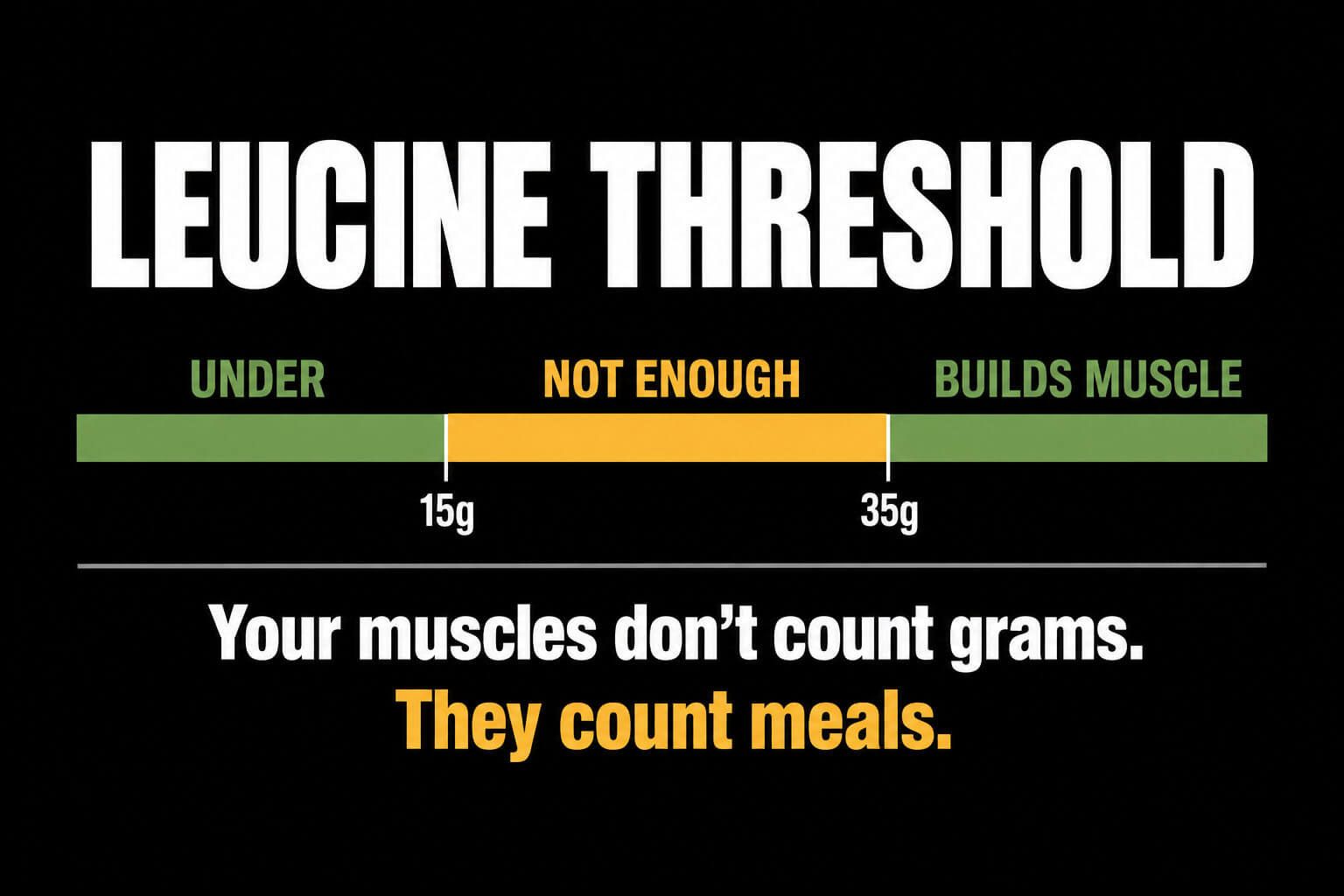
And it's not just the daily total. Your muscles only build when a single meal is big enough to trigger it, which after 50 means roughly 35-40 grams of protein at a sitting. Eat 130 grams spread across snacks and small plates, and you can hit your number while triggering almost nothing.
Your muscles don’t count grams. They count leucine-rich meals.
Add fiber-rich foods, good carbs to fuel your training and your brain, and a structure that removes decision fatigue from your eating habits.
Meal timing, protein targets, repetitive defaults.
Not a diet. A system!
Don’t eat less. Eat more protein, structure your meals, and let the system do the work willpower can’t.
Myth #5: “Carbs are the enemy.”
The truth: Cutting carbs produces fast results that don’t last. And costs you energy, performance, and muscle along the way.
Low-carb and ketogenic diets are popular for a reason: they work quickly. Water weight drops, the scale moves, and motivation spikes. But much of that early loss is water, and it comes back when you go back to eating normally.
The muscle loss during restriction doesn’t come back as easily.
Here’s what carbohydrates do: they fuel your training, protect muscle tissue, feed your brain, and regulate mood and focus for an executive who needs to perform cognitively at a high level all day and then train effectively. Chronically depleted glycogen stores are a real liability.
Carbs aren’t the problem. Is the type of carbs and timing. Refined sugars and highly processed foods will work against you. Whole-food carbs like beans, rice, potatoes, and fruit, eaten around training, work for you.
This isn’t permission to eat whatever you want. (You know the processed stuff works against you.)
It IS a reframe.
Meaning… your total daily calories and how much protein you get matter far more for fat loss than whether carbs are on the plate.
Stop eliminating carbs. Start choosing better carbs.
Myth #6: “Go hard or go home.”
The truth: Men who make the best long-term progress are not the ones who train the hardest. They’re the ones who train consistently and recover.
This is particularly common among high achievers. The same intensity that built your business or career gets pointed at the gym. And it backfires. Overtraining, injury, burnout, weeks off to recover, starting over. Sound familiar.
More is NOT better. BETTER is beter.
Feeling destroyed after a session is not a badge of honor. It’s often a sign of too much volume, too fast.
The adaptation happens during recovery, not during training. If you're not recovering, you’re not progressing.
There’s no meaningful benefit to two-hour gym sessions for a man over 50 trying to build strength and lose fat. Forty focused minutes with the right exercises, executed with good form and
progressive overload, beat ninety minutes of unfocused volume.
Train with intensity. But respect recovery. Three quality sessions per week.
Myth #7: “You need a gym to get results.”
The truth: A small, well-chosen set of equipment, or even a decent hotel gym, is enough to run a complete strength program.
This is the myth that often gives execs or business owners permission to do nothing. No gym near my office. I’m traveling three days a week. No time to drive, park, change, train, shower, and get back.
So nothing happens.
The equipment required for a strength program is minimal. A set of adjustable dumbbells, resistance bands, and a pull-up bar cover the majority of what you need to start. With an adjustable bench and a few kettlebells, you have a home gym that serves you as well as most commercial facilities.
I build my
online strength coaching
around this. Every workout has a home version and a hotel gym version. The program travels with you because your lift doesn’t pause and neither should your training.
Stop waiting for the perfect gym situation. A pair of adjustable dumbbells and 40 minutes is enough to start. And enough to make measurable progress.
Each of these myths shares the same thing.
They make fitness feel harder, more time-consuming, and more dependent on circumstances than it needs to be.
Many men I work with are not starting from zero. They have drive, discipline, and decades of knowing how to execute. What they need is a system that fits their life. Not a fitness culture built for 25-year-olds with unlimited time and nothing to lose.
That’s what I built my
online training program
to be.
If you’re ready to stop running the wrong playbook and start building something that lasts, I work with a small number of online clients at a time.
Book a free 20-minute strategy call and let’s look at exactly where you are and what needs to change.